
FOR FOUNDERS AND CEOs
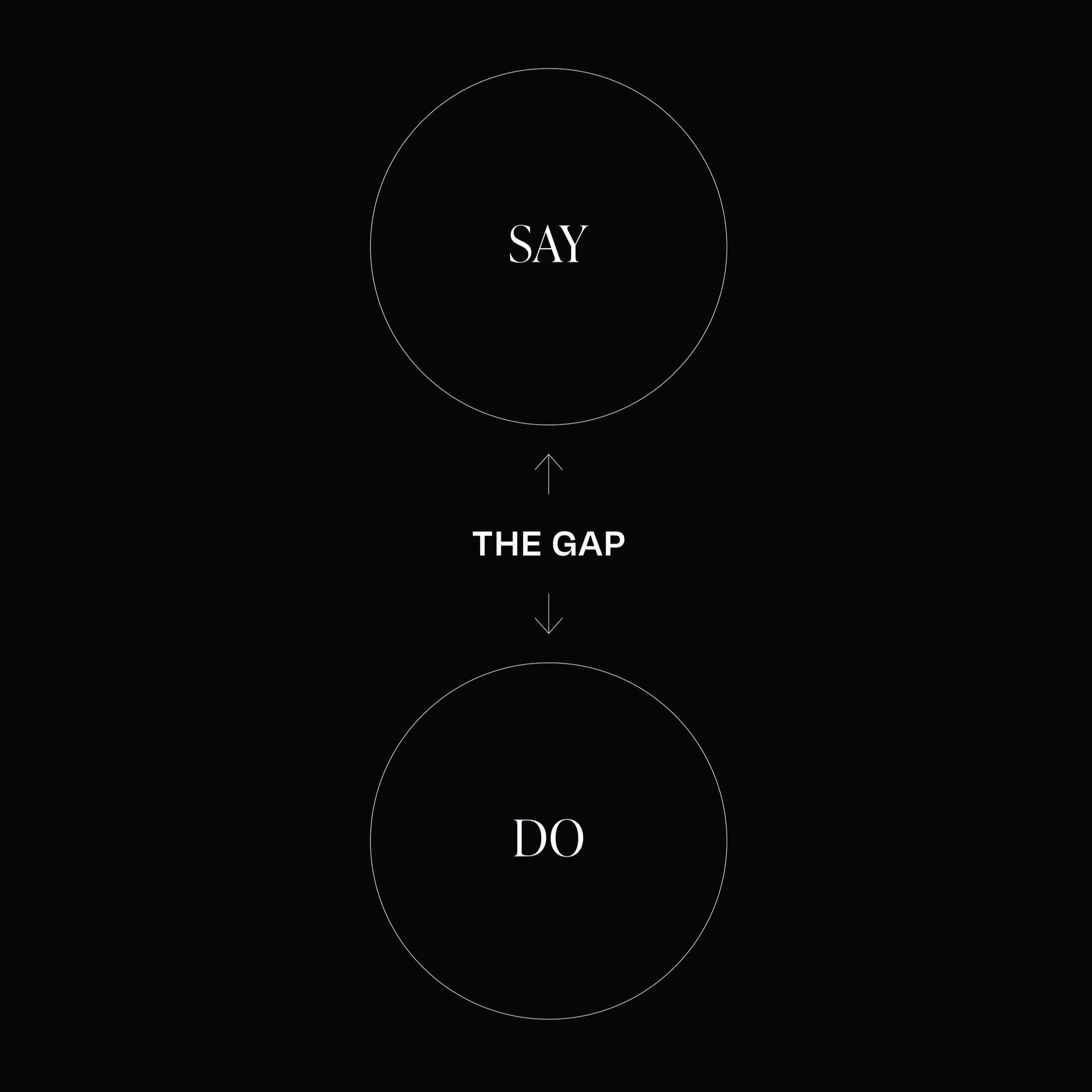
Your company says one thing. It does another. That's the Say-Do Gap.
The deck says premium. Sales gives the discount anyway. The careers page promises one company, and new hires meet another. Each gap looks small. Together they are why prices get negotiated, good people leave, and every hard call lands on your desk.
The Say-Do Gap™ is the distance between what a company says it believes and what its decisions prove under pressure.
Customers don't pay for what you say. They pay for what you prove.
Every company runs two versions of itself. The one it describes, and the one it runs.
WHAT IT IS
The say is everything the company puts in words: the website, the pitch, the mission, the values on the wall. The do is everything it decides: the price it held or gave away, the hire it made, the feature it shipped, the deal it took that it should have turned down.
The Say-Do Gap is the distance between the two. It rarely shows up on a dashboard. It shows up as a price that won't hold, a deal that stalls late, and a story that changes depending on who tells it. And it widens every time someone makes one more exception and explains it away.
WHERE IT STARTS
Nobody named what the company believes. Everything else filled the space.
Some companies never wrote it down. Some lost it on the way from 15 people to 60. Some have three versions, one per executive. Some have it framed in the lobby and missing from every decision. Either way, the company runs on a stand-in: money, product or growth. None of them tells anyone what to refuse.
So the purpose says one thing, the vision another, and the positioning a third. The culture becomes whatever the loudest manager rewards. Every team makes reasonable calls. They just aren't making them against the same standard.
Then pressure arrives. A down quarter. A merger. A new CEO. A new CMO with a rebrand in the first-90-days plan. None of them opens the gap. Each one shows you how wide it already is.
THE SELF TESTHow wide is your Say-Do Gap?
Count each “We do” that happened this quarter.
WE SAY
"We know what we stand for."
WE DO
Ask three people and get three answers.
WE SAY
"Our look and website show who we are."
WE DO
We apologize for both.
WE SAY
"We say no to what doesn't fit."
WE DO
We said yes anyway.
WE SAY
"We're worth the price."
WE DO
We discount to make the sale.
WE SAY
"We tell one story."
WE DO
It changes with whoever is telling it.
WE SAY
"My team owns the decisions."
WE DO
The hard ones land on me.
WE SAY
"Our values guide us."
WE DO
Our best people get a pass.
WE SAY
"This is how we treat people."
WE DO
It depends on who they get.
None: Ask the person closest to your customers to count. Then compare.
1 to 2: The gap is open and it hasn't cost you much yet. This is the cheap time to close it.
3 to 5: It has reached your customers and your pricing. That's worth 20 minutes.
6 to 8: The company runs on exceptions and you're the one holding it together. Let's talk this week.
The distance between what you say and what you do is the Say-Do Gap™. That's the diagnosis.
HOW IT CLOSES
A rebrand changes what you say. It can't hold what you do.
That's why most fixes don't last. They start in the middle, with a new look and a new message, and they stop on launch day. Closing the gap takes three stages, in this order. Each one stands on the last.
NAME IT
Belief System™
Four working sessions with the person at the top. One system: the belief, what it demands, where it positions you, and how your team decides without you. Not a mission statement. An operating standard.BUILD IT
Brand Build
About eight weeks. The rebrand, built on the belief: voice, identity, and a new name if the current one can't carry it. I set the standard. Your team, your agency or my partners produce it.HOLD IT
Belief Advisory™
Monthly sessions on the decisions in front of you: pricing, hires, products, campaigns. Each quarter we lay what the company said beside what it did. You run the company. The belief runs through it.The cost is the proof.
A founder I work with turned down a national retail account, shelved a finished collection, and killed a fabric his team liked. None of it was written down. When I put the belief under those decisions on one page, he flinched. Then he saw what it was: a record of what he'd already paid for. His company had been doing the belief for years. Now it could say it, and his team could hold to it without him.
"What began as a simple rebrand quickly became something far deeper. Scott helped us uncover and articulate the core belief, positioning, and voice at the heart of our mission."
—Mario DeMatteo, Co-Founder, Sown Gardens
Questions about the Say-Do Gap.
-
The Say-Do Gap™ is the distance between what a company says it believes and what its decisions prove under pressure. It's the space between the values on the wall and the discount sales gave yesterday.
-
Every company has some gap. The real questions are how wide it is and where. Count the eight pairs in the self-test. If you discount to make the sale, the story changes with whoever is telling it, and the hard calls still land on you, the gap already shows in your numbers.
-
Marketing is usually where it gets noticed, because marketing is where the company talks. It starts upstream, in decisions about price, people, product and which deals to take. That's why a new campaign or a rebrand can't hold it closed.
-
A belief nobody named. When no one has written down what the company stands on, every team fills the space with its own read, and pressure decides the rest.
-
Name the belief, build the brand on it, then hold the company to it one decision at a time. That's the Belief System™, Brand Build and Belief Advisory™, in that order.
-
No. You don't need it written down, or even a clear problem. Come with a decision you keep circling, a hunch something's off, or just to see if I'm the right call.
START HERE
Tell me what you’re facing.
A gap you can feel but can't name yet. A decision you keep circling. Or no agenda at all, just a look at whether I'm the right call. In twenty minutes, I'll listen, ask the questions nobody inside the company can, and show you where the gap shows up in yours.
Then I'll tell you the best path forward, whether that's the Belief System™, Brand Build, Belief Advisory™, or nothing from me at all. This isn't a pitch. It's the start of the work.